Kamadeva
The worship of Kamadeva is performed for devotion, wisdom, and inner stability.
Kamdev Mool Mantra
Om Kamadevaya Namah
Day
Friday
Color
Green
Bhog
Fruits
Choose Reading Section
Select one section and continue your paath in focused reading mode.
Quick Facts
Reading Style
One section at a time
Core Essence
Devotion, clarity, and spiritual discipline
The Story and Significance of Kamadeva
A clear devotional introduction for readers searching for meaning, worship practice, and available paath.
The worship of Kamadeva is performed for devotion, wisdom, and inner stability.
The Story of Kamadeva
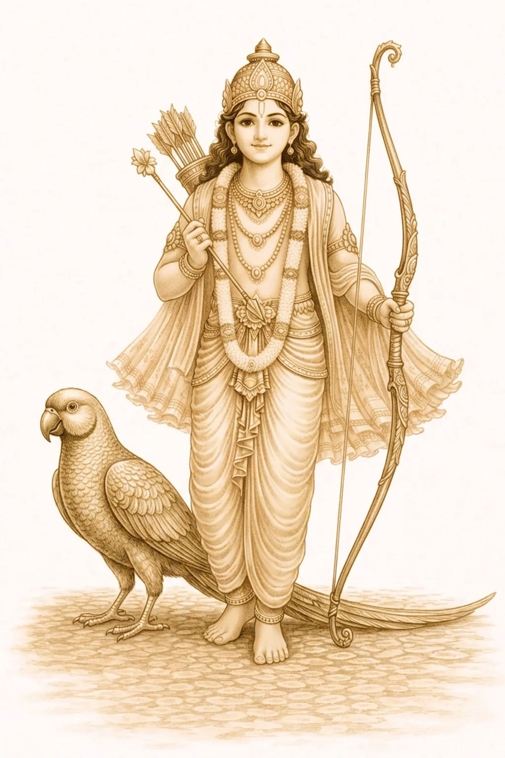
Kamadeva is revered in Hinduism as the deity of love, beauty, desire, attraction, and spring. He is considered one of the most handsome and enchanting among the gods. He carries a bow made of flowers and five floral arrows that awaken love and attraction in the heart. Devotees know him by many names, including Manobhava, Ananga, Madana, Smara, and Pushpadhanva. He is regarded as the divine force that inspires love and sustains the continuity of life throughout creation.
Kamadeva holds an important place in Hindu scriptures. The Atharva Veda mentions him as one of the primordial principles of creation. His stories are described in detail in the Vishnu Purana, Shiva Purana, and Kalika Purana. He is not only the deity of worldly love but is also seen as a symbol of the divine love between the individual soul and the Supreme.
The story of Kamadeva's origin is fascinating. According to one tradition, he emerged from the mind of Lord Brahma. As Brahma was engaged in creation, the desire for the expansion of life arose within him, and from that desire Kamadeva was born. Another tradition describes him as the son of Lord Vishnu and Goddess Lakshmi. His consort is Rati, the goddess of love and beauty.
Kamadeva's five famous flower-arrows are known as Aravinda, Ashoka, Amra, Navamallika, and Nilotpala. Through these arrows, he inspires different forms of love and attraction. His vehicle is a parrot, and his banner bears the emblem of a makara (mythical sea creature), earning him the title Makaradhvaja. The spring season is especially associated with him.
Choose Reading Section
Select one section and continue your paath in focused reading mode.