

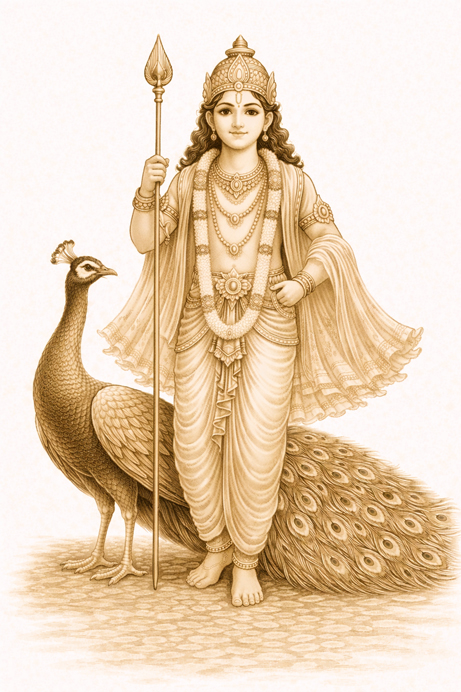
Kartikeya Ji
The worship of Kartikeya Ji is performed for courage, discipline, and divine youthful energy.
Root Mantra
Om Saravanabhavaya Namah
Day
Tuesday
Color
Red
Bhog
Panchamrit
Festivals
Skanda Shashthi
Navratri
Choose Reading Section
Select one section and continue your paath in focused reading mode.
Quick Facts
Recitation Style
One prayer at a time
Main Essence
Courage, discipline, and divine youthful energy
The Story and Significance of Kartikeya Ji
A clear devotional introduction for readers searching for meaning, worship practice, and available paath.
The worship of Kartikeya Ji is performed for courage, discipline, and divine youthful energy.
The Story of Kartikeya Ji
Kartikeya Ji is regarded as one of the most valiant, radiant, and powerful deities in Hinduism. He is worshipped as the God of War, the commander of the divine army, and the son of Lord Shiva and Goddess Parvati. In South India, he is especially famous by the names “Murugan,” “Skanda,” “Subrahmanya,” and “Shanmukha.” His life symbolizes courage, wisdom, discipline, and the protection of righteousness.
In ancient times, there was a mighty demon named Tarakasura. Through severe penance, he received a boon from Lord Brahma that he could only be defeated by the son of Lord Shiva. At that time, Lord Shiva was deeply absorbed in meditation and had become detached from the world after the loss of Goddess Sati. Therefore, Tarakasura believed that his end would never come.
Gradually, Tarakasura became tyrannical. He began troubling the gods, sages, and humans. Frightened, all the gods approached Lord Vishnu and Lord Brahma. It was then revealed that only the son of Lord Shiva could destroy Tarakasura.
After this, the gods prayed to Goddess Parvati. To attain Lord Shiva as her husband, Goddess Parvati performed intense penance. Pleased by her devotion and dedication, Lord Shiva married her. Some time later, a divine energy emerged from Lord Shiva, which was carried by Agni (the Fire God) and later by the sacred river Ganga. From this divine radiance, Kartikeya Ji was born.
Choose Reading Section
Select one section and continue your paath in focused reading mode.